

Signs Your Autistic Child Will Talk: What Parents Should Look For
Learn the encouraging signs that may show your autistic child is developing toward spoken communication, plus practical ways to support speech and language at home. Wondering about the signs your autistic child will talk? Discover key communication milestones and how early autism support can encourage speech development.
For many parents of autistic children, one question can stay on their minds for months or even years:
“Will my child ever talk?”
The answer is different for every child.
Autism affects communication differently. Some autistic children begin speaking later than expected, some develop a few words and gradually build their vocabulary, while others communicate more effectively through gestures, pictures, communication devices, or other forms of communication.
There is no single sign that can guarantee that an autistic child will develop spoken language. However, there are several encouraging communication behaviours that may show that your child is developing important skills that can support speech and language.

1. Your Child Is Babbling or Making Different Sounds
Babbling, humming, experimenting with sounds, or repeatedly making certain vocalisations can be an encouraging sign.
Before children use words, they often learn that their voice can be used to interact with the people around them.
You may notice sounds such as:
- “Ba-ba”
- “Ma-ma”
- Squeals or humming
- Attempts to copy sounds
- Different sounds for different needs
Rather than focusing only on whether the sound is a clear word, pay attention to whether your child is using their voice intentionally.
2. They Try to Imitate You
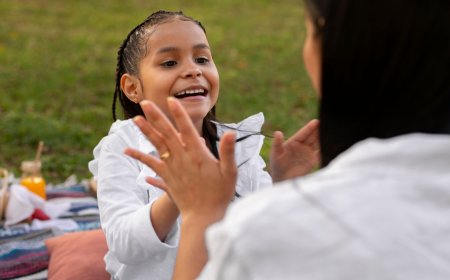
Imitation is an important early communication skill.
Your child may copy:
- Clapping
- Facial expressions
- Animal sounds
- Mouth movements
- Simple actions
- Sounds or parts of words
A child who is beginning to imitate movements and sounds is learning an important principle: “I can copy what another person does.”
This ability can later support learning new sounds and words.

3. They Understand Simple Instructions
Sometimes a child understands much more language than they are able to say.
For example, your child may respond when you say:
“Bring your shoes.”
“Come here.”
“Give me the cup.”
“Sit down.”
Understanding language is called receptive language, while using words to communicate is known as expressive language.
Growing receptive language skills can provide an important foundation for communication development.
4. Your Child Uses Gestures to Communicate
Pointing, reaching, waving, pulling a parent's hand, nodding, or showing an object may not be spoken language, but they are still meaningful forms of communication.
For example, your child might:
- Point at a snack they want
- Bring you their shoes when they want to go outside
- Lead you towards the fridge when hungry
- Wave goodbye
- Reach towards a favourite toy
These behaviours show that the child is beginning to understand that communication can influence another person's actions.
That is an important developmental step.
5. They Attempt to Get Your Attention
Another encouraging sign is when your child actively tries to share something with you.
They may bring you a toy, make a sound when something exciting happens, look towards you during play, or guide your attention towards something they find interesting.
Communication is not only about asking for things. It also involves sharing experiences with another person.
Helping children enjoy these back-and-forth interactions can support future communication development.
6. They Have Started Using a Few Words
Some autistic children develop language gradually.
A child might begin with only a few useful words such as:
“Mum.”
“Water.”
“More.”
“Go.”
“No.”
These first words may appear inconsistently at first. What matters is continuing to create opportunities for the child to use them meaningfully without placing unnecessary pressure on them.
Over time, single words may develop into combinations such as:
“More juice.”
“Mummy come.”
“Want ball.”
Every child's progress will be different.
7. They Repeat Words or Phrases
Some autistic children repeat words, phrases, songs, adverts, or lines from television. This is commonly known as echolalia.
Parents sometimes assume that repeated language has no value. However, repetition may sometimes form part of a child's developing communication system.
With appropriate support, some children gradually learn how to use familiar words and phrases more flexibly and meaningfully.
How Parents Can Encourage Communication at Home
You do not need to turn every interaction into a lesson.
Everyday activities can create valuable opportunities for communication.
Try:
- Talking during dressing, eating and bathing
- Naming objects your child is interested in
- Using simple and clear sentences
- Reading picture books together
- Singing repetitive songs
- Giving your child time to respond
- Offering simple choices
- Celebrating communication attempts
- Following your child's interests during play
Most importantly, do not force speech.
Communication should feel useful, safe and rewarding.
What If My Autistic Child Is Still Not Talking?
A child who is not yet speaking still has thoughts, feelings, preferences and needs.
Spoken words are only one form of communication.
Depending on the child, professionals may support communication using gestures, pictures, visual communication systems, sign language, or Augmentative and Alternative Communication (AAC).
Parents should not wait for speech before helping a child develop effective ways of communicating.
Early assessment can also help identify the child's individual communication strengths and areas where additional support may be beneficial.
Supporting Communication at Bright Path Autism Academy
At Bright Path Autism Academy, we understand that every autistic child's communication journey is different.
Our autism-focused programs along Kiambu Road, Kenya combine structured learning with individualized developmental support.
Through our Speech Therapy, Occupational Therapy, ABA Therapy, Early Intervention and individualized education programs, we help children develop communication, social, learning and everyday independence skills according to their unique needs.
We also work closely with parents and caregivers so that strategies used during therapy and learning can continue at home.
Give Your Child the Right Support
If your child has delayed speech, limited communication, or has recently been diagnosed with autism, professional assessment can help you better understand their current communication abilities and the support they may need.
Contact Bright Path Autism Academy today to learn more about our autism programs and speech therapy support.
📍 Kugeria Road, Kiambu Road, Kenya
📞 +254 724 235 049
✉️ info@brightpathautismacademy.com
Website: brightpathautismacademy.com
Every word matters—but communication begins long before the first word.
What's Your Reaction?
 Like
0
Like
0
 Dislike
0
Dislike
0
 Love
0
Love
0
 Funny
0
Funny
0
 Angry
0
Angry
0
 Sad
0
Sad
0
 Wow
0
Wow
0